
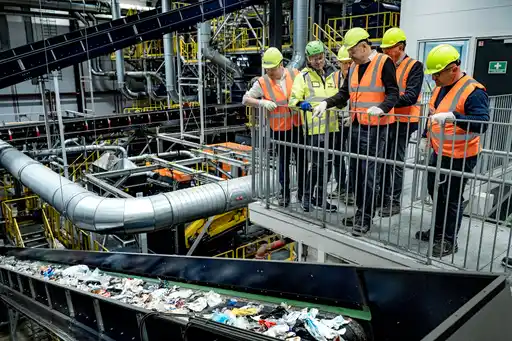
Waste sorting and Chinese plastic were on the agenda when the Minister for the Environment visited ReSource Denmark in Esbjerg today.
A ministerial visit to Esbjerg-based ReSource Denmark brought together representatives from the plastics and waste industries for a joint dialogue on industry challenges. Among other things, how we can ensure the best possible recycling of our plastic waste.
How can we take better care of our own waste in Denmark – and how can we work together to solve the challenges facing the recycling and waste industry?
These were some of the issues discussed when Environment Minister Magnus Heunicke and three spokespeople from the SVM government visited Denmark's largest plastic sorting facility, ReSource Denmark in Esbjerg, today, Monday, January 26.
Esbjerg Mayor Jesper Frost Rasmussen also attended the meeting, along with representatives from the plastics industry and the VANA collective agreement.
In Esbjerg, the minister was welcomed by ReSource Denmark's CEO, Flemming Horn Nielsen, who began the visit with a tour of the facility, which sorts 90,000 tons of plastic waste from Danish households annually.
There were three particularly important topics on the agenda for the subsequent dialogue. These included the need for continued source separation—i.e., sorting at home in Danish households—and the challenges this poses for the industry when municipalities combine fractions such as plastic and metal.
"Source sorting by citizens results in clean material flows that industry can actually reuse, thereby achieving high recycling rates," explained Flemming Horn Nielsen during the tour, where he also demonstrated why recycling rates decline when sorting machines have to handle materials other than plastic, such as plastic mixed with hard metal.
Industry calls for more regulation
During the meeting, ReSource Denmark and the Danish Plastics Industry Association expressed a shared desire for more political regulation to support a complete Danish value chain within plastic recycling.
"It is difficult to sell more environmentally friendly recycled plastic in a market where cheap, new plastic, especially from China – often produced using Russian oil and gas – is flooding across the EU border and driving down the prices of recycled plastic. There is therefore an urgent need to strengthen the market for recycled plastic. This can be done, among other things, by imposing political requirements on the amount of recycled plastic that must be included in new plastic products. We cannot wait until 2030, when the EU will introduce regulations, because we risk large parts of the industry simply having to close down before then," says Flemming Horn Nielsen, CEO of ReSource Denmark.
In addition, the economic framework for extended producer responsibility was discussed.
It was a positively disposed minister who stated after the meeting that:
"Strengthening the circular economy is an important priority for me. ReSource makes a crucial contribution to enabling us to recycle more plastic in Denmark instead of sending it for incineration or exporting it. It is fascinating to see firsthand how technology in this area is developing and, at the same time, to see the great potential in strengthening the circular economy and thereby converting even more waste into valuable resources." In addition to Environment Minister Magnus Heunicke, the event was also attended by environmental spokespeople Erling Bonnesen (V), Henrik Frandsen (M) and Thomas Monberg (S), as well as Esbjerg Mayor Jesper Frost Rasmussen, Christina Busk, Head of Environmental Policy at Plastindustrien, and Marianne Roed Jakobsen, CEO of VANA, also participated in the meeting. And, of course, ReSource Denmark CEO Flemming Horn Nielsen.